A hurricane category is read as a severity score, and it is really a timetable. The forecast arrives days early for a hurricane, which is both the advantage and the trap. The difference between a two and a four is hours of warning, and hours decide whether you prepare or leave. For a household the practical question is how long the power will be out and what has to run until then. The category tells you when to start, not whether to stay, and the two are different decisions made in the first day of the forecast. The aim here is to turn the category into a preparation list matched to the time available.
Reading the Category First
What Each Category Actually Changes
The numbers describe wind, and wind sets the damage to roofs, trees and lines. A one strips shingles and drops branches; a three removes roofs and closes roads for days. Wind scales with the square of its speed, so the step from a two to a four is not twice the force but roughly four times it. Ask hurricane categories how do they work and the answer is all wind; the water is the part the number leaves out, and water is what floods the low streets and keeps them flooded. What those storms did at your address turns the abstract category into a list of repairs and exits. Roof age matters more than the number, since a twenty-year-old shingle field will lift at a two.
Arrival Window and Warning Time
Track the arrival window rather than the landfall point, because wind and rain arrive hours before the eye. A slow storm gives you time to leave and to prepare; a fast one takes that away, and a storm that stalls is worse still because the rain lands on the same ground twice. If the window is shorter than your drive, the decision is already made. Write the window on paper, since the phone holding the forecast is the phone that dies on day two, and set the alarm for its midpoint rather than its start. Fill the car on the way home from work rather than on the morning of the warning, when the queue runs round the block. Both jobs take an afternoon, and both buy hours the forecast lacks.
Lower-Category Preparation
Staying in Place Through a Weak System
A one or a two is survivable for most well-built houses, provided the roof is sound and the garden is clear. The work is unglamorous: clear the drains, secure the gate, charge everything, fill the bath. The stay-or-go call is easier in June than in September, because in June nobody is watching the cone, so write it down early and tell the household. A house that has never flooded can still lose a roof, and a house that has flooded twice rarely loses anything else. A generator that has sat in the garage for two years should be started in June, not tested for the first time in the dark.
Securing and Stocking for a Short Outage
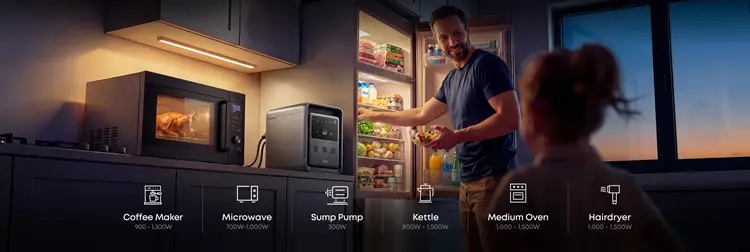
Assume two or three days without power and stock for that rather than for a week. Water, food that needs no cooking, batteries, a radio and a charged station cover the realistic case, and counting supplies in meals rather than in cans makes the list concrete. An Anker SOLIX S2000 covers that list without fuel: 2,010Wh runs a fridge, a router and the lights for roughly a day and a half, with nothing to store and no fumes to manage. Count the days in meals and the shopping list stops being a guess, and a headlamp in every room beats one torch in a drawer.

Upper-Category Preparation
The Evacuation Decision Point
At three and above the question is not whether to leave but when. Orders are issued for surge rather than wind, which is why an inland household may be told to stay while a coastal one is told to go. Leave early enough to arrive in daylight and accept that the roads will be slow; book the inland room before the order is issued, because they fill the moment the cone shifts. The cost of leaving for a storm that weakens is a tank of fuel, and the cost of staying is not symmetric. Take the car you would trust in a traffic jam, and tell somebody outside the zone where you are going.
Protecting a House You Leave Behind
Board the windows, move anything that can become a projectile, and turn off the water and the gas at the mains. A house that is being left should look abandoned from the road: bins inside, furniture up, nothing loose in the yard. Photograph every room before you lock the door, because the insurance conversation starts with a picture, and note the meter reading in case the utility argues about a week without power. Unplug the electronics and leave the fridge shut. Turn the gas off at the meter, and move the patio furniture into the garage rather than leaving it in the yard.
Conclusion
Match the effort to the forecast, because the two costs are not the same. One is an afternoon and a tank of fuel; the other is not a cost you can plan for at all. Read the number, read the water, and decide in May rather than in August, when the decision is still cheap and nobody is arguing in a hardware aisle. Read the number as a schedule and the dread turns into a list with times against it. The cheapest preparation is the decision made early; the most expensive is the one made in a queue.
Also Read
- https://smartsimiles.com/turning-down-the-volume-on-opioid-cravings-what-early-glp-1-studies-actually-found/
https://smartsimiles.com/claude-sonnet-5-still-the-workhorse-a-year-later/
https://smartsimiles.com/buying-thc-a









1 thought on “How Do You Prepare for a Hurricane?<p class="post-updated-date">🕓 <span class="updated-label">Last updated on</span> <time datetime="2026-11-12T08:39:40+00:00">November 12, 2026</time></p><script type="application/ld+json"> { "@context": "https://schema.org", "@type": "BlogPosting", "mainEntityOfPage": { "@type": "WebPage", "@id": "https://smartsimiles.com/how-do-you-prepare-for-a-hurricane/" }, "datePublished": "2026-11-12T08:34:59+00:00", "dateModified": "2026-11-12T08:39:40+00:00" } </script>”