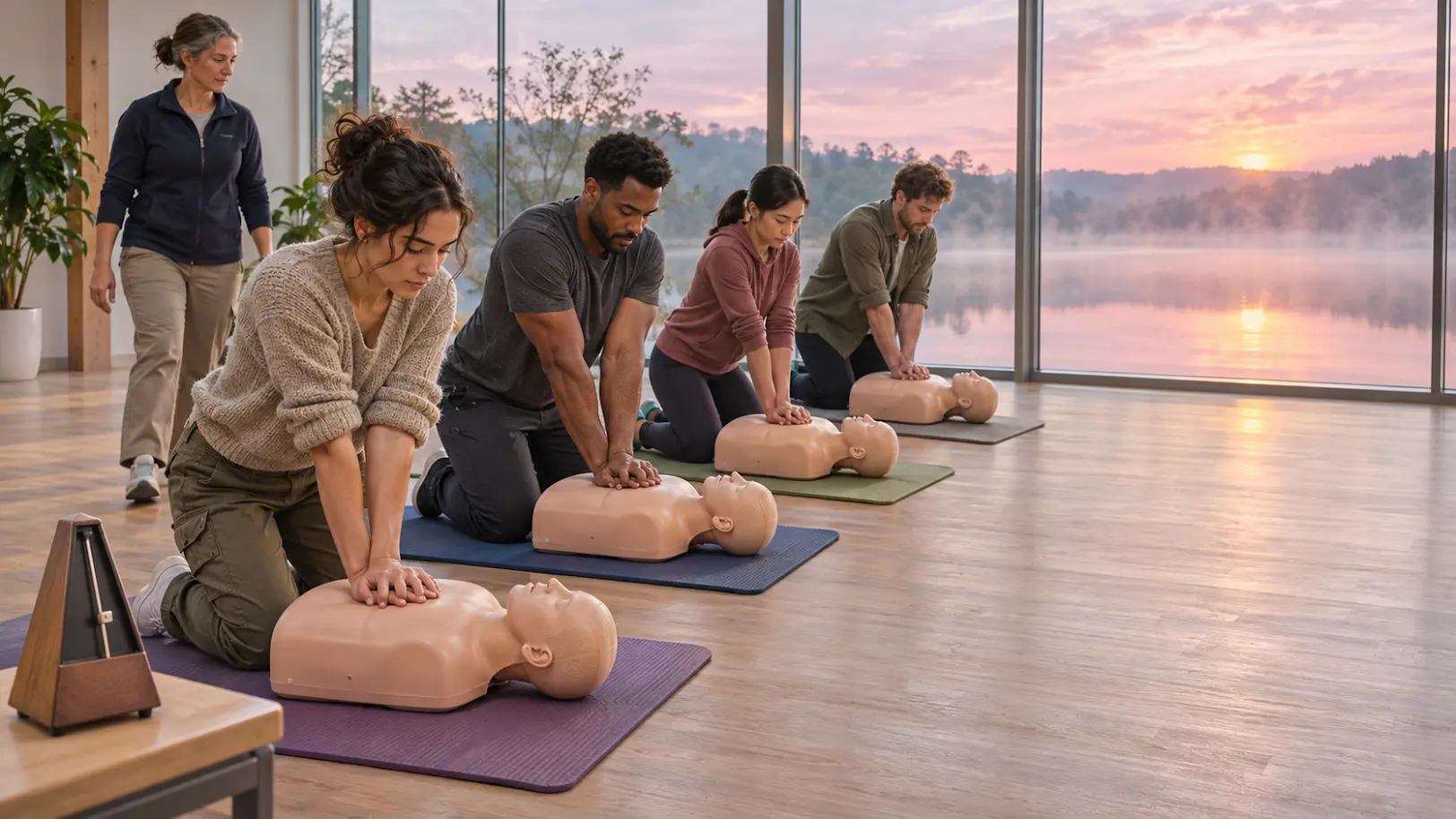
A good simile makes an idea easy to see. “Calm as a lake at dawn.” “Steady as a metronome.” Those phrases are fun to write, but they also describe something real: the way trained people act in an emergency. This guide explains similes, gives original examples about staying calm and ready, and shows how the real skill is built through practice, such as Ottawa CPR courses that let you rehearse the moment before it happens.
What Is a Simile?
A simile is a comparison that uses the word “like” or “as.” It tells the reader that one thing is similar to another, so they can picture it quickly.
- “Her voice was as steady as a heartbeat.” (comparing her voice to a heartbeat)
- “He moved like a well-oiled machine.” (comparing his movement to a machine)
A metaphor makes the comparison without “like” or “as.” It says one thing is another: “Her voice was a steady heartbeat.” Both are useful. Similes feel lighter and more direct, which makes them popular in school writing, stories and everyday speech.
How Do You Build a Good Simile?
You don’t need a special talent. Follow four steps:
- Pick the quality. What do you want to describe? Calm, speed, strength, readiness?
- Find a vivid comparison. Choose something your reader can picture quickly, like a lake, a clock or a compass.
- Connect them with “like” or “as.” Try both and see which sounds better.
- Keep it fresh. Skip comparisons that everyone has heard, such as “cool as a cucumber.” A new image works better.
Then read it aloud. If it makes you see something, it’s working.
What Are Some Similes About Staying Calm?
Here are original examples, with what each one means.
- “She stayed as calm as a lake at dawn.” She was peaceful and in control, even when things around her were busy.
- “His breathing was slow, like a tide going out.” He stayed relaxed and steady.
- “As quiet as a library in the middle of the storm, she gave her instructions.” She was composed when everything else was loud.
- “He was as steady as a lighthouse in rough water.” Others could rely on him to stay put and guide them.
- “Her hands were as still as a stone in a stream.” She wasn’t shaken by the rush around her.
- “The team stayed cool, like glass on a winter morning.” Everyone kept a clear head.
- “He spoke as evenly as a ticking clock.” His voice was calm and regular.
- “She was as unhurried as a river in summer.” She didn’t rush, but she also didn’t stop.
What Are Some Similes About Being Prepared?
- “They were as ready as a fire crew at the station.” They had trained and knew their roles.
- “He packed his kit like a pilot checking a cockpit.” He was careful and thorough.
- “Her plan was as clear as a map with the route marked.” Everyone knew what to do.
- “The team rehearsed like a band before opening night.” They practised until it felt natural.
- “He knew where everything was, like a chef in their own kitchen.” He could find what he needed without searching.
- “As prepared as a lifeguard on a busy beach, she scanned the room.” She was alert and ready to act.
What Are Some Similes About Acting Fast?
- “He reacted as quickly as a spark catching dry grass.” His response was immediate.
- “She moved like a sprinter off the blocks.” She started fast and with purpose.
- “The call was made as fast as a flash of lightning.” There was no delay.
- “They came together like pieces of a puzzle.” Each person knew their part.
- “Her thoughts clicked into place like a seatbelt.” She decided quickly and clearly.
Why Do These Similes Match Real First Aid?
Because they describe habits that training builds. Here are a few real-life links.
Staying calm. Calm doesn’t mean you feel no fear. It means you act anyway. Practice makes the steps familiar, so your hands know what to do even when your heart is racing.
Steady like a metronome. This one is more literal than it sounds. According to Heart & Stroke’s guidelines, chest compressions for an adult should be given at 100 to 120 per minute, which is about two every second, at least 5 cm (2 inches) deep and no more than 6 cm (2.4 inches). People often practise with a metronome or a song with a matching beat.
Ready like a lifeguard. Preparation is the point. Heart & Stroke’s three steps for a cardiac arrest are simple: call 9-1-1 and shout for an AED, start CPR right away, and use an AED as soon as one is available. Heart & Stroke also stresses that you can’t hurt someone by trying, you can only help.
Fast like a spark. Time matters. According to Heart & Stroke, about 60,000 cardiac arrests happen outside hospitals in Canada every year, and only one in 10 people survives. CPR and an AED together can double a person’s chance of survival, and every minute without them lowers the odds by about 10%.
A simile can describe calm and readiness. It can’t create them. That takes practice.
What Does Training Actually Teach?
A hands-on course turns a nice phrase into a skill. You practise on mannequins, learn to use an AED trainer and get feedback from an instructor who watches your technique. Courses commonly cover CPR for adults, children and infants, choking response and AED use.
Many providers offer a blended format, with theory online and a shorter in-person session for skills. That suits students, teachers and busy workers. If you want to compare formats and dates, find Coast2Coast First Aid sessions and ask any provider the same questions.
What Does Ontario Require From Employers?
If you’re an employer, a few rules apply. Ontario’s workplace first aid requirements are set by WSIB Regulation 1101. It applies to workplaces with WSIB-covered employers. If you aren’t sure whether your business is covered, the WSIB can confirm. The Ontario Occupational Health and Safety Act (OHSA) also sets general duties for employers to protect workers.
The thresholds depend on how many workers are on a shift:
- 1 to 5 workers per shift: at least one worker with Basic First Aid
- 6 or more workers per shift: at least one worker with Intermediate First Aid
- 200 or more workers per shift: a first aid room with a qualified attendant
Certificates are valid for three years. On June 22, 2026, the WSIB aligned its First Aid Program with the national CSA Z1210:24 standard. Emergency First Aid became Basic First Aid, and Standard First Aid became Intermediate First Aid. The thresholds did not change, and earlier certificates stay valid until they expire. Only providers the WSIB lists can deliver the new certifications.
A note for Ottawa readers. Many workplaces in the city are federally regulated, and those may follow federal rules instead of Ontario’s. Check which rules apply to your workplace.
Can You Write Your Own Similes About Safety?
Yes, and it’s a good classroom or workshop exercise. Try these starters:
- “A prepared team is like ___ because ___.”
- “Staying calm in an emergency is as ___ as ___.”
- “A first aid kit is like a ___ because it ___.”
- “Knowing CPR is as useful as ___ because ___.”
Share them, then ask which ones are fresh and which ones are clichés. The activity gets people thinking about what readiness really means, and it makes the ideas easy to remember.
If you are looking for first aid training near Rideau Street and King Edward Avenue, the Sandy Hill neighbourhood near the University of Ottawa, or surrounding areas in Ottawa, you may reach out to Coast2Coast First Aid & Aquatics in that area.
FAQs
Q: What is a simile?
A: A simile is a comparison that uses “like” or “as” to show that two things are similar, such as “calm as a lake at dawn.”
Q: What is the difference between a simile and a metaphor?
A: A simile uses “like” or “as.” A metaphor says one thing is another without those words. “Her voice was as steady as a heartbeat” is a simile. “Her voice was a steady heartbeat” is a metaphor.
Q: How fast should chest compressions be?
A: For an adult, Heart & Stroke’s guidance is 100 to 120 compressions per minute, which is about two per second, at least 5 cm (2 inches) deep and no more than 6 cm (2.4 inches).
Q: How long is an Ontario workplace first aid certificate valid?
A: Three years.
Q: How many first aiders does a small workplace need in Ontario?
A: It depends on workers per shift. For one to five, at least one worker should hold Basic First Aid. For six or more, at least one should hold Intermediate First Aid. Confirm how it applies to you with the WSIB, and check whether federal rules apply instead.
Also Read
- https://smartsimiles.com/turning-down-the-volume-on-opioid-cravings-what-early-glp-1-studies-actually-found/
- https://smartsimiles.com/claude-sonnet-5-still-the-workhorse-a-year-later/
- https://smartsimiles.com/buying-thc-and-cbd-online-how-to-read-a-coa-decode-labels-and-shop-responsibly/









1 thought on “Similes About Staying Calm Under Pressure: Examples, Meanings and What They Teach<p class="post-updated-date">🕓 <span class="updated-label">Last updated on</span> <time datetime="2026-11-13T05:33:19+00:00">November 13, 2026</time></p><script type="application/ld+json"> { "@context": "https://schema.org", "@type": "BlogPosting", "mainEntityOfPage": { "@type": "WebPage", "@id": "https://smartsimiles.com/similes-about-staying-calm-under-pressure-examples-meanings-and-what-they-teach/" }, "datePublished": "2026-11-13T05:31:58+00:00", "dateModified": "2026-11-13T05:33:19+00:00" } </script>”