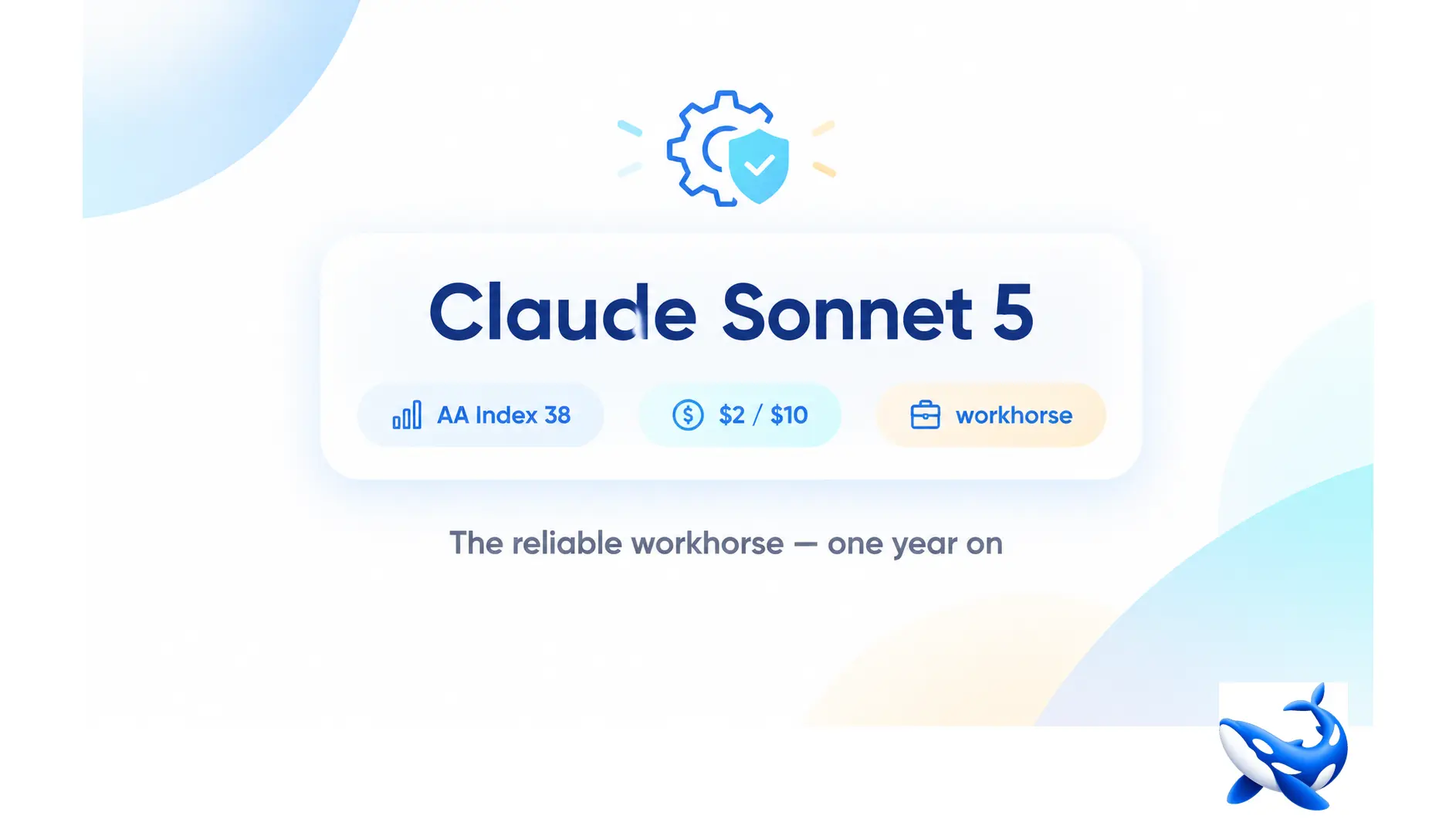
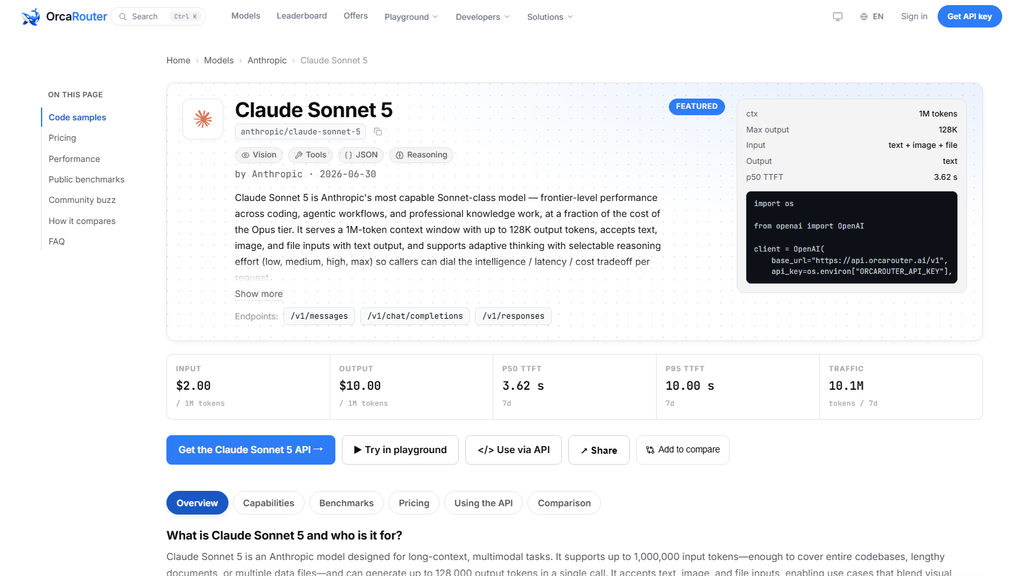
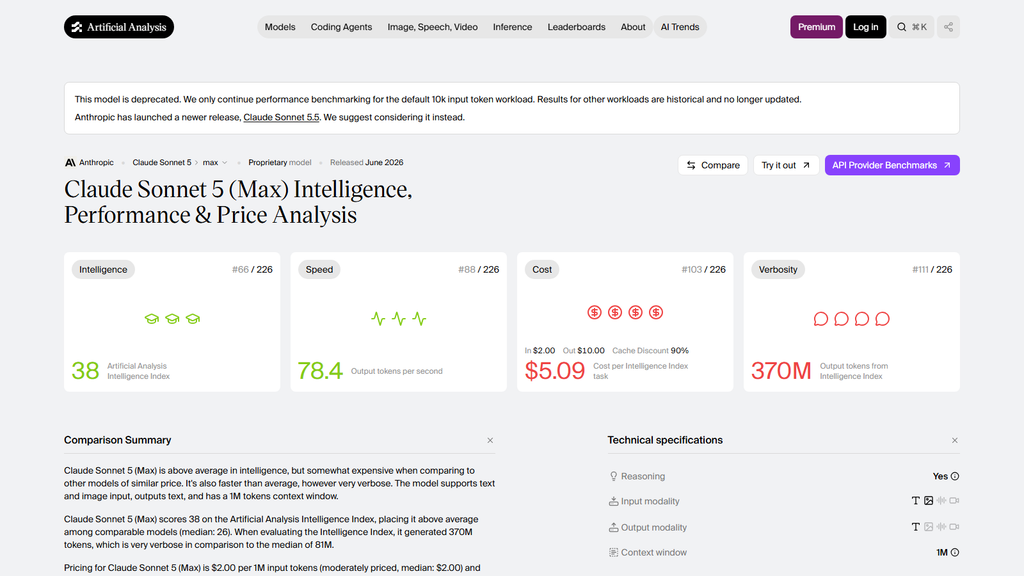
On OrcaRouter we host the Claude Sonnet 5 model — Anthropic’s mid-tier workhorse, shipped on June 30, 2026, and more than a year later it still sits at a $2 / $10 rate card with a 1M-token context window, the same card its successor now carries. It scores 38 on Artificial Analysis’s Intelligence Index at the max reasoning setting, its measured p50 time-to-first-token in production is 3.62 seconds, and it is served at list price on the same key as every other Anthropic model, with the linked page showing the real usage telemetry for the endpoint.
The unglamorous number is the one that makes this model interesting: 10.7 million tokens processed in the trailing seven days on a card that a newer generation now prices identically. A year in, production traffic still flows to the model that launched the generation.
Why an old model still moves 10.7M tokens a week
Software migrates on trust, not on spec sheets. Teams that put Sonnet 5 in front of production traffic a year ago have it wired into evaluation suites, regression tests and human-reviewed workflows — and nothing about their pipeline forces a move. The migration calculus for a workhorse is brutal: the new model has to be better on the exact slice of traffic that pays the bill, and that proof costs engineering time that does not show up on anyone’s roadmap.
The 3.62-second measured p50 first token is a large part of the answer too. Latency is the attribute that survives migration — it is not a benchmark you argue about, it is a number your users feel. A card that has answered fast for a year is a card whose latency your infrastructure has already absorbed.
The weekly number confirms the picture: 10.7 million tokens is not a trickle of legacy calls, it is a production workload that teams route on purpose. When traffic of that size keeps flowing to a year-old card at a price the new generation shares, the honest conclusion is that the market has already run the migration test — and many teams decided the old endpoint is what their latency budget is built around.
The honest ledger
| model | release | context | input / output | p50 TTFT | AA index (config) | per-task cost |
| Claude Sonnet 5 | 2026-06-30 | 1M | $2 / $10 | 3.62 s | 38 (max) | $5.09 |
| Claude Sonnet 5.5 | 2026-09-28 | 1M | $2 / $10 | 4.14 s | 56 (max with fallback) | $5.46 |
Release dates and rate cards are what Anthropic lists; the index and per-task cost are Artificial Analysis’s live readings; the TTFT column is production telemetry from the linked page. The table is the whole argument in two rows: the same price, the same context window, and a successor that scores higher but answers a little slower. For a workhorse workload, that is a real trade, not a clear win.
Notice also that the successor’s per-task cost is higher: $5.46 against $5.09 on the same standard task set, because the newer model reads and writes more tokens to produce the same answer. The higher score is partly a more expensive answer. For a workload that asks short questions and reads short answers, the older card’s ledger line is the one that wins.
That is why a careful team does not flip a migration switch on launch day. You shadow-traffic a slice of your own production, measure your own p50, and let the number decide. Nothing in this table says Sonnet 5 is wrong for a stable workload — it says the successor is worth a controlled test, not a leap of faith.
The controlled test has a second benefit: it measures behavior, not just scores. A shadow run against your own traffic produces your own p50, your own refusal rate, your own cost-per-task on the inputs that actually pay the bills — numbers no leaderboard row contains. That is the evaluation a workhorse deserves, because a workhorse is chosen for the long run, and the long run is measured in production.
When the older card is the right choice
There is a class of workload where an older, battle-tested endpoint is a feature rather than a liability. Compliance-reviewed workflows where the model’s behavior on your exact prompt templates is documented and signed off; batch jobs where determinism across a month matters more than raw score; integrations pinned to an API behavior that a new model generation may or may not preserve. For those, the 38 (max) independent score is not a discount — it is the price of the stability you are already paying for.
The independent reading is honestly reported here: 38 at max reasoning is not competitive with the current generation’s best scores. The article is not arguing that Sonnet 5 is underrated. It is arguing that a workhorse card is chosen on a ledger where the index is one line among many, and on that ledger Sonnet 5 still wins its share of seats.
None of that is a claim that Sonnet 5 is secretly the smartest card on the board. It is the opposite claim, stated carefully: for a defined, stable, latency-sensitive slice of work, an endpoint whose behavior is known beats an endpoint whose behavior is merely newer. The 38 (max) figure is the honest price of that stability, and teams that value the stability are willing to pay it.
What a year of production data buys you
The linked page does not show a benchmark score or a vendor claim — it shows the endpoint’s own seven-day window: a p50 first token of 3.62 seconds and 10.7 million tokens of real traffic. That is the number a team can actually evaluate against its own latency budget, because it is the same kind of number the team would produce itself. For a model this mature, production evidence matters more than a fresh score.
There is also a mild caution in the same page: at 10.7 million tokens a week, this card is no longer where Anthropic’s newest traffic goes. The 1M context and $2 / $10 card remain exactly what they were, but the model is now a stable endpoint rather than a headline. If your workload only needs what this card delivers, that stability is precisely the point; if your workload has been waiting for the generation to improve, the successor’s numbers are the thing to evaluate next.
One more reading of the telemetry is worth making explicit: 3.62 seconds is faster than the successor’s measured 4.14, which means the old card is not merely equal on the ledger — it is ahead on the attribute that production users feel first. Speed is the one number in this article that did not move in the successor’s favor, and for latency-sensitive workflows it is the number that decides.
The takeaway
Claude Sonnet 5 is a year-old card that still carries 10.7 million tokens a week because stability, known latency and documented behavior are worth real money to production teams. Its 38 (max) index score is honest but mid-pack, its $2 / $10 card is unchanged, and its measured 3.62-second first token keeps it viable for latency-sensitive work. It is not the model to migrate to — it may already be the model you are happy not to migrate away from.
The same page that shows its telemetry also lets you compare the successor in one glance. When you are ready to evaluate, the migration test is one config change on the same key.
Sourcing note: release date, context window and rate card are what Anthropic lists and have not been independently reproduced. The Intelligence Index score and per-task cost are from Artificial Analysis’ live model page, read 2026-10-08, and the 38 was measured at the max reasoning setting. The p50 time-to-first-token and seven-day token volume are OrcaRouter production telemetry from the linked model page. All checked 2026-10-08.
Also Read
- How to Rebuild a Daily Routine After Completing Treatment
- What Does ☕ Mean? Teacup Emoji Meaning Explained
- Can You See Who Saved Your Spotify Playlist?