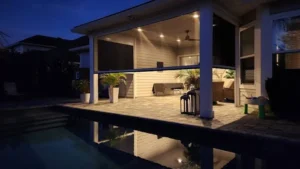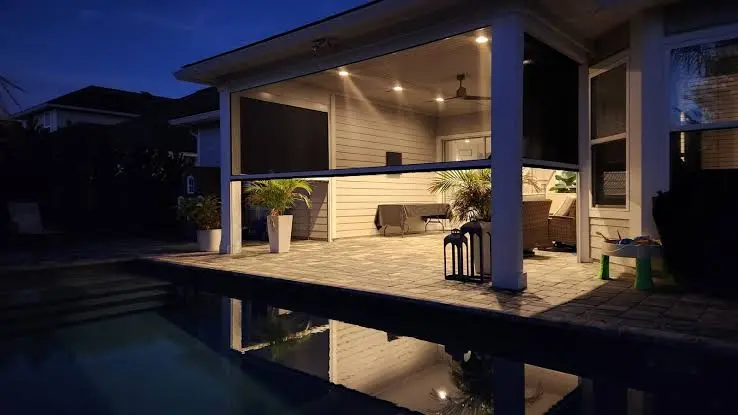
A patio can look spacious when its awning is folded away. Extend the fabric, lower the motorized insect screens, and the same space suddenly has a ceiling, moving edges, and a much narrower path between fixtures and equipment. A light that seemed perfectly positioned on an open wall can end up hidden behind fabric or shining straight into a screen.
That is why outdoor lighting installation around retractable features requires a little more planning than a typical fixed patio. The important measurements are not just the distances between walls and posts. They also include the space occupied by an awning while opening, the path followed by a screen, and the areas a technician needs to reach when something stops working.
For a homeowner considering a lighting design involving Astoria Lighting Co, a useful starting point is to demonstrate the awning and screens in motion, not simply show photographs of the patio. Seeing each feature fully extended and fully retracted can reveal conflicts that a static floor plan misses.
Map the Moving Parts Before Choosing Fixtures
Retractable awnings do not all operate in the same way. Some use folding arms that project outward beneath the fabric. Others include a cassette that houses the rolled material. Motorized screens usually travel down guide tracks, and their bottom bars may sit close to a floor or railing when lowered.
Each part has a working envelope: the space it occupies throughout its movement. A fixture mounted outside that envelope is less likely to be struck or obstructed. One placed just beyond the final stopping position might still be in the path of an arm or bar while the equipment is moving.
Check the full travel, not just the endpoints
Watch the awning deploy from start to finish. An articulated arm can swing through positions that are wider or lower than someone expects. Repeat the exercise while retracting it. For screens, inspect the path of the bottom rail, the side guides, and any fabric that shifts slightly while traveling.
Do not use a hand or a loose object to test whether the moving equipment will clear a fixture. Instead, consult the product’s clearance requirements and have qualified installers confirm where mounting is permitted. A few inches that appear available to the eye may not provide the clearance required by the equipment manufacturer.
Be Careful With Lights Beneath the Awning
An appealing idea is to mount lights directly under the awning, where they can illuminate the dining table like a ceiling. Whether that works depends on the awning design and the lighting product. Fabric moves, folds, and may retain moisture; folding arms and housings are not automatically approved as supports for separate electrical fixtures.
Lights fitted to the building, rather than to a moving component, may be more straightforward to service. Even then, the awning can block or redirect the beam once extended. Downlights that brighten a patio with the awning closed may fall onto the upper surface of the fabric instead of the seating area when it is open.
Expect the same beam to behave differently
Consider a wall-mounted fixture above a patio door. With the awning retracted, it illuminates the first few feet of paving. Once the canopy opens, the fabric may interrupt the light, making the doorway relatively bright while the table farther out remains dim.
In outdoor lighting installation around moving canopies, that mismatch does not always call for a brighter bulb. A separate light beneath a fixed overhang, a suitable fixture on an independent structure, or a different aiming angle may solve the imbalance without directing additional glare toward neighboring windows. Any added equipment must be rated and installed for its location.
Screens Can Turn Gentle Light Into Uncomfortable Glare
A fine mesh screen looks nearly transparent during the day. At night, its appearance depends strongly on where the light originates. Illuminate the screen from close range and the mesh can become conspicuous, especially if the space beyond it is dark. Reflections and scattered light may make it harder to see the garden through the material.
A bright lamp just inside the screen can also attract attention to dust, moisture, and insects on the mesh. Placing the source outside the enclosure brings a different concern: the lamp may shine toward people seated within it.
For outdoor lighting installation in screened patios, the practical test is to evaluate the lights with the screens both raised and fully lowered. Sit in the positions people actually use. Check whether the garden remains visible, whether the dining area is comfortable, and whether the source itself is glaring through the mesh.
Keep Power Cables Away From Guides and Hinges
Motorized features already have electrical equipment, controls, and concealed or exposed cable routes. Additional lighting should not share a moving guide channel, press against the awning mechanism, or interfere with a service cover. A wire that is tidy today can become pinched after repeated movement if it crosses an unsuitable gap.
The proposed route matters as much as the final position of each lamp. A layout provided to Astoria Lighting Co should identify the locations of screen tracks, awning housings, power supplies, and access panels. That information can help separate the lighting wiring from components that need to move or be opened for repairs.
Avoid casually combining electrical controls
It may be tempting to connect patio lights to an existing awning switch or motor circuit. Compatibility cannot be assumed. Motors have their own electrical requirements, and control systems may involve receivers, sensors, or manufacturer-specific electronics. A qualified electrician should determine whether any shared control arrangement is appropriate, rather than making an improvised connection.
The same caution applies to automated routines. A lighting scene that switches on when the awning extends may be convenient, but it should not compromise wind sensors, obstruction protection, or the awning manufacturer’s operating instructions.
Maintenance Access Is Part of the Design
Screens may need cleaning, fabric replacement, guide adjustments, or motor repairs. Awnings may require access to mounting brackets, end caps, and the cassette. Installing a row of fixed lights directly across those service points can make an ordinary repair more expensive and disruptive.
Before finalizing the lighting, ask the screen and awning installers where a technician would stand and which panels might need removing. Keep access routes usable without requiring someone to cut wires or dismantle unrelated fixtures. Check whether doors, ladders, or removable covers need extra space.
There is a related practical concern during cleaning. Water used on an awning or screen can reach nearby fixtures and connections. Outdoor-rated equipment still needs the correct placement and protection for its exposure; a rating alone does not justify directing pressurized water toward electrical parts.
Test One Evening With Every Configuration
The most useful review is not a single photograph of the finished patio. It is a short sequence: awning closed and screens up; awning extended and screens up; then awning extended with screens lowered. Each arrangement changes the direction of light, shadows, reflections, and visibility.
If Astoria Lighting Co is among the providers being considered, sharing that sequence of photographs alongside measurements can make the design conversation specific. For example, the homeowner might explain that the dining table becomes dark when the canopy opens, while a wall fixture causes glare once the screen is lowered. Those observations suggest very different corrections.
It is worth repeating the check while people are seated, not only while standing at the patio edge. A light that causes little discomfort from the doorway can shine directly into someone’s eyes from a chair. Test any dimming or separately controlled zones as well; the best evening setting may change with the patio configuration.
Design for a Patio That Changes Shape
Retractable awnings and motorized screens make an outdoor space flexible, but they also make its boundaries temporary. A successful lighting scheme recognizes the moving equipment as part of the patio rather than an obstacle to work around after fixtures are installed.
Before approving outdoor lighting installation, make sure the plan accounts for movement, visibility through screens, safe wiring, and future access. In discussions with Astoria Lighting Co, the most helpful reference may be a simple demonstration of how the space transforms from an open terrace into a sheltered room. Lighting that respects each version of the space will be more comfortable and easier to live with over time.
Also Read
- ou Can’t Undo)
Building a Diamond Wardrobe: Where Color Fits Alongside Studs, Pendants and Tennis Bracelets
https://smartsimiles.com/the-ultimate-fall-home-winterization-checklist-15-tasks-before-the-first-freeze/