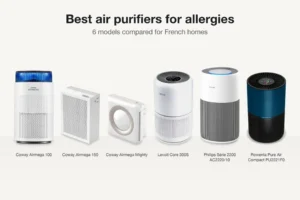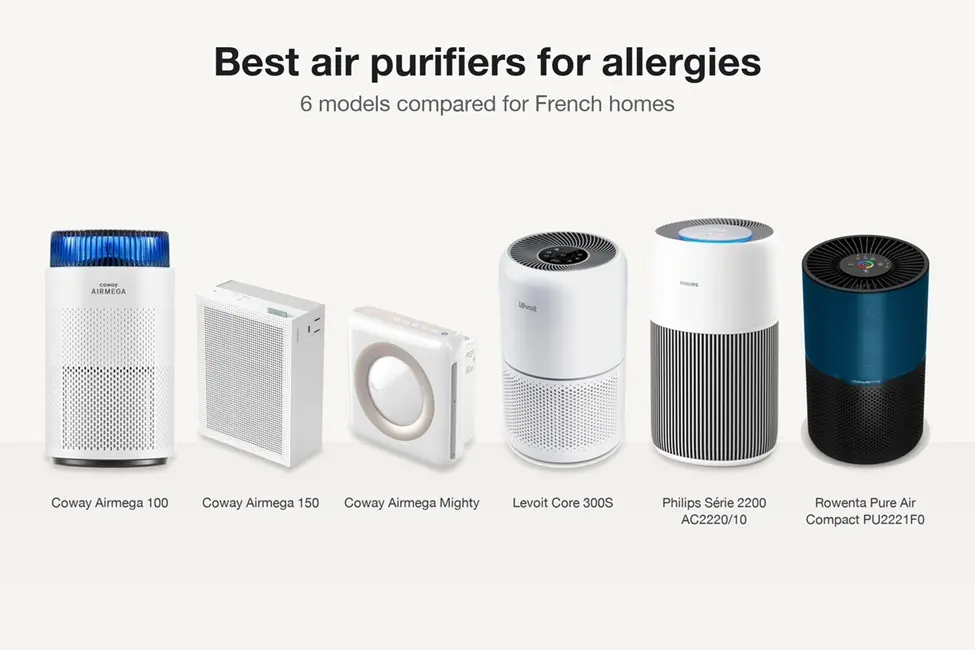
The best air purifier for allergies captures fine airborne particles with a HEPA filter and has a pre-filter you can keep clean. The Ministry of Health says allergies affect about 30% of adults in France. Below are six models sold in France in 2026, matched to the rooms and needs they suit, in alphabetical order, with what a purifier can and cannot do.
At a glance
- For everyday use in a small room: Coway Airmega 100
- For bedrooms and pet owners: Coway Airmega 150
- For living rooms and shared spaces: Coway Airmega Mighty
- For small rooms with app control: Levoit Core 300S
- For app users who want HEPA and carbon: Philips Série 2200 AC2220/10
- For low power use without an app: Rowenta Pure Air Compact PU2221F0
How we chose
Each model is sold on its maker’s French website and has a fine-particle filter, a pre-filter and a sensor. Facts come from the makers’ product pages and user manuals. Room-size and noise figures are left out, as makers measure them in different ways.
The 6 models
Coway Airmega 100: for everyday use in a small room
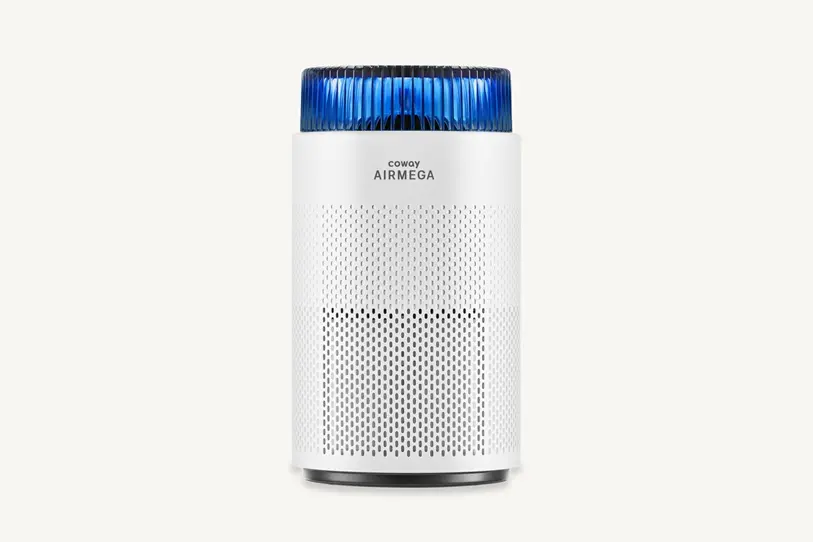
The Coway Airmega 100 uses one 3-in-1 filter with a HEPA layer. Image: Coway.
Key specs: 3-in-1 filter with a HEPA layer, PM2.5 sensor, auto and sleep modes, 25 W, 3.0 kg.
- Pro: one filter to replace.
- Pro: a sleep mode and a soft night light for the bedroom.
- Con: the pre-filter surface is cleaned dry, not washed.
Coway Airmega 150: for bedrooms and pet owners
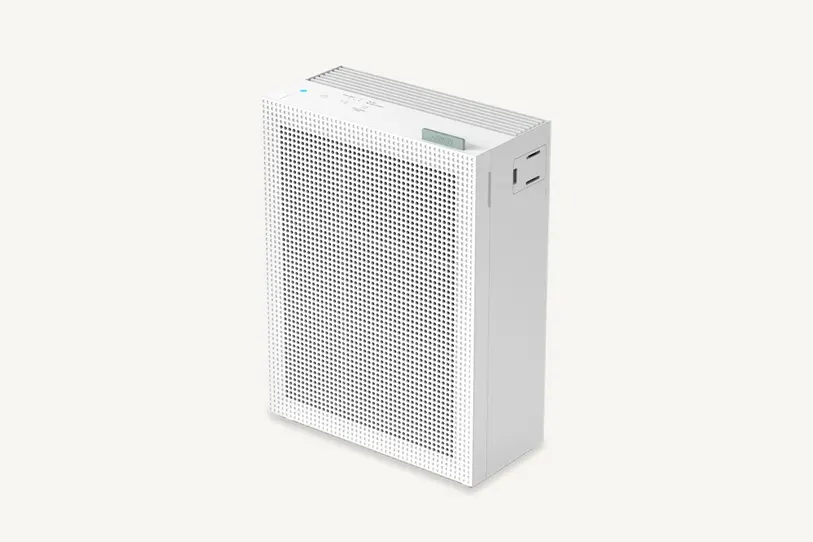
The Coway Airmega 150 has a washable pre-filter that catches pet hair. Image: Coway.
Key specs: washable pre-filter, activated carbon filter, HEPA filter, silent mode, 35 W, 5.5 kg.
- Pro: the pre-filter catches pet hair and can be washed.
- Pro: the manual recommends silent mode while you sleep.
- Con: it needs 20 cm of space on each side.
At 165 mm deep, it fits the gap beside a bed in a small French flat.
Coway Airmega Mighty: for living rooms and shared spaces
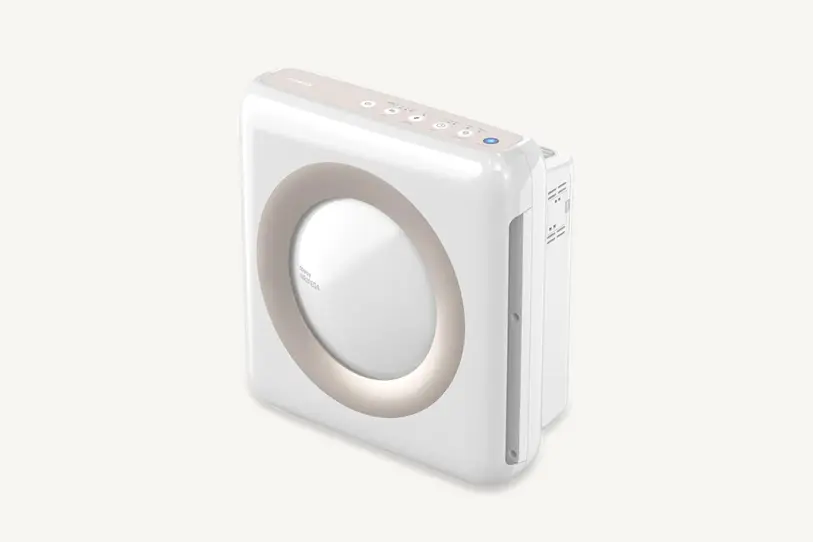
The Coway Airmega Mighty has an eco mode that stops the fan when the air is clean. Image: Coway.
Key specs: washable pre-filter, deodorisation filter, HEPA filter, auto and eco modes, timer, 5.9 kg.
- Pro: its manual lists a maximum airflow of 7.2 m³/min.
- Pro: eco mode stops the fan when the air is clean.
- Con: the manual lists no sleep mode and no app.
The rest of the range is on the website of Coway France.
Levoit Core 300S: for small rooms with app control
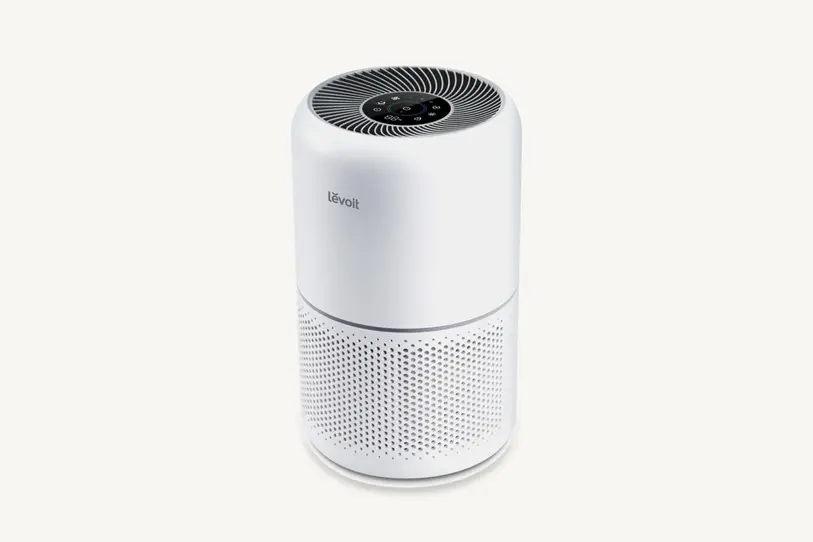
The Levoit Core 300S shows filter alerts in the VeSync app. Image: Levoit.
Key specs: pre-filter, HEPA filter, activated carbon filter, laser dust sensor, auto and sleep modes, 39 W, 2.7 kg.
- Pro: filter alerts appear in the VeSync app.
- Pro: light enough to move from room to room.
- Con: the EU manual says the pre-filter is not cleaned with water.
Philips Série 2200 AC2220/10: for app users who want HEPA and carbon
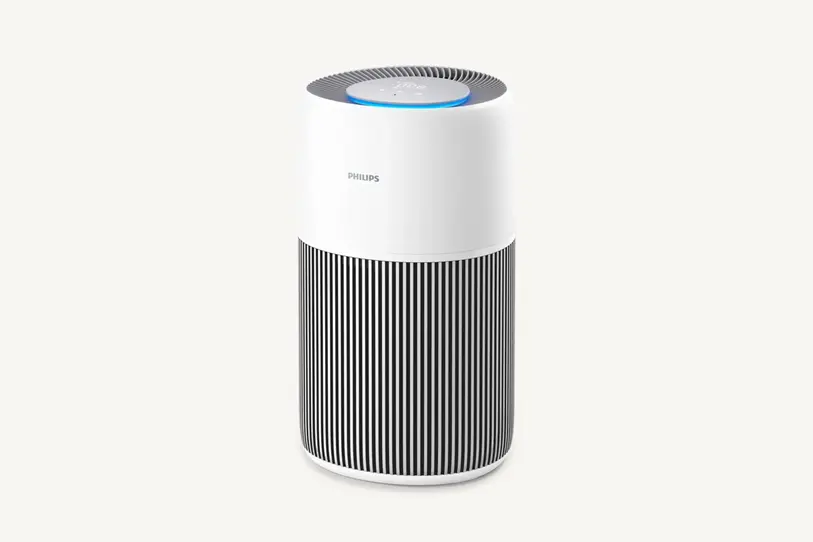
The Philips Série 2200 AC2220/10 pairs a HEPA filter with an activated carbon filter. Image: Philips.
Key specs: pre-filter, HEPA filter, activated carbon filter, PM2.5 sensor, auto and sleep modes, 28 W max, 4.1 kg.
- Pro: control through the Air+ app.
- Pro: a PM2.5 sensor drives the automatic mode.
- Con: Philips does not state whether the pre-filter is washable.
Rowenta Pure Air Compact PU2221F0: for low power use without an app
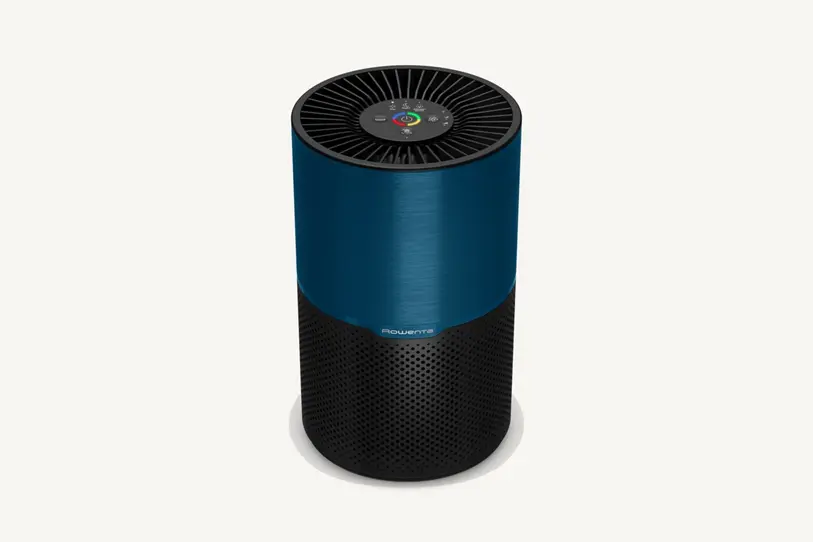
The Rowenta Pure Air Compact PU2221F0 has a maximum power of 15 W and an E12 main filter. Image: Rowenta.
Key specs: pre-filter, E12 filter, activated carbon filter, particle sensor, auto and night modes, 15 W max, 2.3 kg.
- Pro: the lowest maximum power of the six.
- Pro: a filter indicator, with no app needed.
- Con: the main filter is E12, not HEPA.
Rowenta notes that the carbon filter may vary by model.
What should you check before you buy?
The right air purifier for allergies depends on where the allergens come from and where you spend your time.
- A HEPA filter for fine airborne particles, as described by the maker.
- A pre-filter you can clean, especially with a cat or dog at home.
- A sensor and auto mode, so the fan reacts when you vacuum or shake out bedding.
- A quiet night setting if the unit will run in a bedroom.
A purifier treats only the air that passes through it. It does not clean bedding, rugs or a sofa where allergens settle, so washing and vacuuming still come first.
FAQs
Do air purifiers help with allergies?
A purifier with a HEPA filter can capture fine particles, including some pollen and pet allergens, while they are in the air. That supports cleaner indoor air, but it does not treat or prevent symptoms. An air purifier supplements ventilation and source control. It does not replace them and is not a medical treatment.
Is an E12 filter the same as a HEPA filter?
No. E12 and HEPA are different filter classes. Rowenta lists an E12 filter for the Pure Air Compact, while the other five models here list a HEPA filter. If HEPA filtration matters to you, check the maker’s description of the main filter before you buy.
Can I leave an air purifier on all night?
Most models have a night, sleep or silent setting for this. Coway’s Airmega 150 manual, for example, recommends silent mode while sleeping and advises against long use in a sealed room. Air the bedroom each day and check the manual for placement.
Does an air purifier replace airing the home?
No. ANSES advises airing the home for at least 10 to 15 minutes every day, even in winter. Airing brings in fresh air and removes moisture. Close the windows again before you switch the purifier on, so it is not filtering outdoor air.
The short version
For allergies in a French home, look for a HEPA filter, a pre-filter you can clean and a sensor-led auto mode. Choose a quiet model for the bedroom and a higher-airflow one for the living room, keep airing every day, and see a doctor about persistent symptoms.
Also Read
- https://smartsimiles.com/turning-down-the-volume-on-opioid-cravings-what-early-glp-1-studies-actually-found/
- https://smartsimiles.com/claude-sonnet-5-still-the-workhorse-a-year-later/
- https://smartsimiles.com/buying-thc-and-cbd-online-how-to-read-a-coa-decode-labels-and-shop-responsibly/