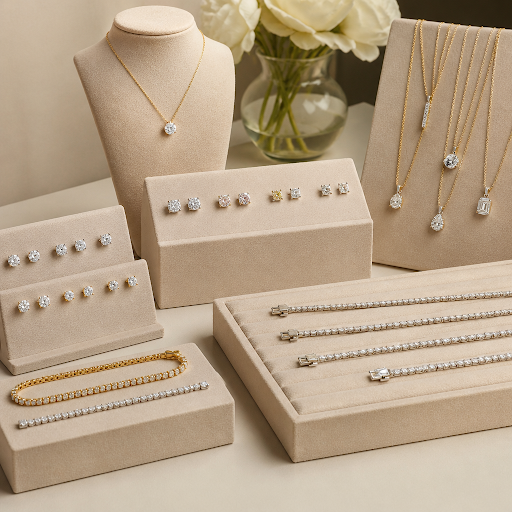
Most people do not buy fine jewelry in a planned sequence. A pair of studs arrives as a graduation gift, a pendant marks a birthday, a bracelet shows up after a promotion, and ten years later the jewelry box is a collection of unrelated moments. That is fine — but it is also why so many drawers hold pieces that never get worn together. A diamond wardrobe works better when the classics are chosen to layer, and when one or two colored pieces are allowed to do the talking.
Below is a practical way to think about the four pillars most buyers return to — stud earrings, pendants and cross necklaces, tennis bracelets, and fancy color diamonds — plus the trade-offs that matter once you are actually comparing two items side by side.
Start with studs, because they set the scale for everything else
Diamond studs are the only piece of fine jewelry many people wear seven days a week, which makes them the anchor of a wardrobe rather than an accessory to it. The first decision is not carat weight — it is how the earring sits. A solitaire round in a four-prong basket reads tall and catches light from the side; a lower-profile setting disappears under a phone or a pillow and survives daily life better. If you sleep in your earrings, that single detail will matter more than a slight difference in brightness.
Scale is the second decision. Smaller studs read as punctuation and are easy to layer with a second or third piercing. Larger stones become the focal point and tend to compete with a statement necklace. A useful rule: if you already own a pendant you wear constantly, keep the studs modest and let the neckline lead. If you dress simply and rarely layer, go bigger with the ears and let them carry the outfit.
Clusters, hearts and motifs
Cluster studs, heart shapes, clover motifs and squares with gemstone accents solve a different problem. They give you visual presence and a bit of design personality without relying on one large stone. Clusters in particular spread light across several facets, so they often look livelier in dim restaurant lighting than a single stone of similar footprint. Motif earrings are also the easiest entry point if you want color — a halo of emerald, ruby or sapphine-toned stones around a diamond center reads festive without going full statement.
Pendants and cross necklaces: chain length does half the work
A pendant is judged almost entirely on where it lands. A shorter chain sits at the base of the throat and shows above most crew necks and collars; a longer one drops toward the sternum and works under open shirts or over knitwear. If you intend to layer two chains, separate them by a few inches so the pendants do not clash or tangle, and vary the weight — a fine cable chain under a slightly heavier one looks intentional, two identical chains look like an accident.
Cross necklaces deserve a note of their own because the design range is enormous. A slim, pavé-set cross in 14K white gold reads modest and modern and tucks under a collar without a bulge. A broader cross with larger stones becomes a statement piece and generally wants to be worn alone. Check the bail: a well-proportioned bail keeps the cross facing forward instead of twisting sideways every time you move, which is the single most common complaint about pendants of any shape.
Tennis bracelets: fit, flexibility and the comparison trap
Tennis bracelets are where buyers most often get lost in specification sheets. Two bracelets with the same total weight can look very different depending on how many stones are used, how the links articulate, and whether the setting is four-prong, channel or bezel. More links means more flexibility and a smoother drape around the wrist; fewer, larger stones means more individual sparkle but a stiffer feel. Ask about the clasp as much as the stones — a box clasp with a figure-eight safety catch is the detail that keeps a bracelet on your arm.
Fit matters more here than in any other category. A tennis bracelet should rotate freely but not slide over the wrist bone when your arm hangs down. If you plan to wear it alongside a watch, consider a slightly narrower line so the two do not fight for space. The market has also widened considerably in recent years, and roundups such as this Forbes guide to lab-grown diamond tennis bracelets are useful for understanding how style, length and setting options are presented across the category before you narrow down what you actually want on your wrist.
Where fancy color diamonds change the conversation
Colorless diamonds are graded on the absence of color. Fancy color diamonds are valued for the opposite — the presence, strength and evenness of hue. That inversion changes how you shop. Brightness and face-up appeal become more important than chasing a specification, and settings are designed to support the color rather than compete with it. White gold keeps the surrounding metal neutral so a yellow, pink or blue-toned stone keeps its character; a halo of small colorless diamonds makes the center hue read deeper by contrast.
Earrings are the most forgiving place to start with color. Unlike a ring, earrings are seen at a distance, in motion and against your hair and skin rather than against other jewelry, so even a modest stone registers. They also pair cleanly with the classics you already own: colored studs with a plain white-gold pendant, or colored drops with a tennis bracelet and nothing else. The result feels considered rather than matched, which is the goal.
Seeing pieces in person before you commit
Color is the one thing photography struggles to convey honestly, which is why many shoppers want both an online catalog to browse and a physical counter to confirm. Leon Diamond works that way: an online store plus a showroom on West 47th Street in New York City’s diamond district, with collections built around diamond studs, pendants and cross necklaces, tennis bracelets and fancy color diamond earrings, alongside gemstone pieces using emerald, ruby and sapphire accents in 14K and 18K white gold. In-person appointments are available for anyone who wants to compare hues under real light, and the company’s blog carries buying guides if you would rather do the groundwork first. International shipping covers buyers who cannot get to the counter.
Buying with longevity in mind
Fine jewelry has quietly joined watches in the category of things people buy partly to keep, which is one reason the conversation around luxury watches and fine jewelry as modern collectibles has grown so much. That mindset is useful even if you never intend to resell. It pushes you toward certified diamonds, clean construction, classic proportions and pieces you can describe accurately years later — all of which also happen to be the characteristics of jewelry you keep wearing.
A few habits make the difference between a collection and a pile: keep documentation with the piece rather than loose in a drawer; have prong settings checked roughly once a year if you wear something daily; store chains flat or hanging instead of coiled; and take jewelry off before the gym, the pool and the beach, where impact, chlorine and sand do more damage than ordinary wear ever will.
A sequence that actually works
- Buy the studs first, sized to how you dress rather than to the largest option you can justify.
- Add a pendant at a chain length you have measured against your own necklines, not guessed.
- Choose a tennis bracelet by fit and clasp, then by stone layout.
- Introduce color last, in earrings, where it has room to be seen.
Follow that order and each new piece earns its place against what you already own. Reverse it and you end up with a statement that has nothing to make a statement against — which is how beautiful jewelry ends up unworn.
https://smartsimiles.com/everyday-impact-how-lifestyle-choices-shape-chronic-health/