That little tire-shaped warning light on your dashboard has a way of ruining your morning. You check your tires, they look fine, you even fill them up to the right pressure and the light stays on anyway.
It’s one of the most common (and most annoying) car issues drivers run into, and the good news is that it’s usually an easy fix.
Your Tire Pressure Monitoring System (TPMS) doesn’t always update itself the moment you correct a tire’s pressure. In most cases, it just needs to be reset or given a chance to “relearn” the new readings.
The exact steps depend on your vehicle and the type of TPMS it uses, but in this guide, we’ll walk through every reset method available, explain why the light comes on in the first place, and help you figure out when it’s a quick fix versus a sign of a real sensor problem.
Understanding TPMS Before You Reset It

Before jumping into reset steps, it helps to know what’s actually happening behind that dashboard light. TPMS comes in two main forms, and knowing which one your car uses will save you time and guesswork.
Direct TPMS uses physical sensors mounted inside each wheel, usually attached to the valve stem. These sensors measure actual air pressure and transmit that data wirelessly to your car’s computer. Because they’re small battery-powered units, they typically need to “relearn” new pressure values after a change which is why a manual reset or relearn procedure is often required.
Indirect TPMS, on the other hand, doesn’t use physical sensors at all. Instead, it estimates tire pressure by monitoring wheel rotation speed through your car’s ABS system an underinflated tire spins slightly faster than a properly inflated one. This type usually just needs a quick recalibration, often as simple as driving for a few minutes.
Not sure which one you have? Your owner’s manual will specify it, or you can check whether your dashboard menu has a “TPMS reset” or “calibrate” option a telltale sign of an indirect system. If your car mentions individual tire pressure readings for each wheel, you almost certainly have a direct system.
Common Reasons the TPMS Light Stays On
If you’ve already filled your tires to the correct pressure and the light is still glowing, one of these is usually the culprit:
The system just hasn’t updated yet. Direct TPMS sensors don’t always report changes instantly — sometimes the car needs a few minutes of driving or a manual reset before it recognizes the new pressure.
Recent tire work. Rotating, replacing, or repairing a tire can temporarily confuse the system, especially if a sensor was removed and reinstalled during the process.
Temperature swings. Tire pressure drops roughly 1 PSI for every 10°F drop in temperature. A cold snap overnight can be enough to trigger the warning, even if nothing else has changed.
A dying sensor battery. TPMS sensor batteries typically last 5–10 years. As they wear down, they may send weak or inconsistent signals, triggering false or intermittent alerts.
Physical sensor damage. Potholes, curbs, or improper tire mounting can crack or dislodge a sensor, causing it to stop reporting correctly.
The spare tire. If your spare has its own sensor and it’s low or faulty, it can trigger the warning even though your road tires are fine.
Aftermarket wheels or tires. Non-OEM wheels sometimes lack compatible sensors or require reprogramming to sync properly with your car’s system.
Before You Reset: Prep Checklist
Resetting the TPMS won’t help much if the underlying tire pressure isn’t actually correct so it’s worth getting these basics right first.
Gather your tools. You’ll need a reliable tire pressure gauge (many drivers find the built-in gauges on gas station air pumps inaccurate), an air compressor or access to one, and your owner’s manual for reference.
Find the correct PSI not from the tire itself. This trips up a lot of people: the number printed on your tire’s sidewall is the maximum pressure it can safely hold, not the recommended pressure for your vehicle. The correct number is on a sticker inside the driver’s side door jamb, or listed in your owner’s manual.
Check all four tires and the spare. Don’t just check the tire that seems low. Uneven pressure across tires is a common reason the light stays on even after a partial fix. If your spare has a sensor, check that too.
Check pressure when tires are cold. Driving heats up the air inside your tires, which raises the pressure reading and can throw off your numbers. For the most accurate reading, check pressure first thing in the morning or after the car has been parked for at least three hours.
Once your tires are properly inflated across the board, you’re ready to move on to the actual reset methods.
Reset Methods, Step-by-Step

The right method depends on your TPMS type and what your vehicle supports. Try these roughly in order starting with the simplest.
5.1 Drive Reset
The easiest option, and often all an indirect TPMS needs.
- Make sure tires are inflated to the correct PSI first.
- Drive at speeds above 50 mph for about 10 minutes.
- Some systems need a mix of speeds and turns to fully recalibrate.
- This won’t fix a genuinely faulty sensor, but it clears most minor pressure-related warnings.
5.2 Built-In Reset Button
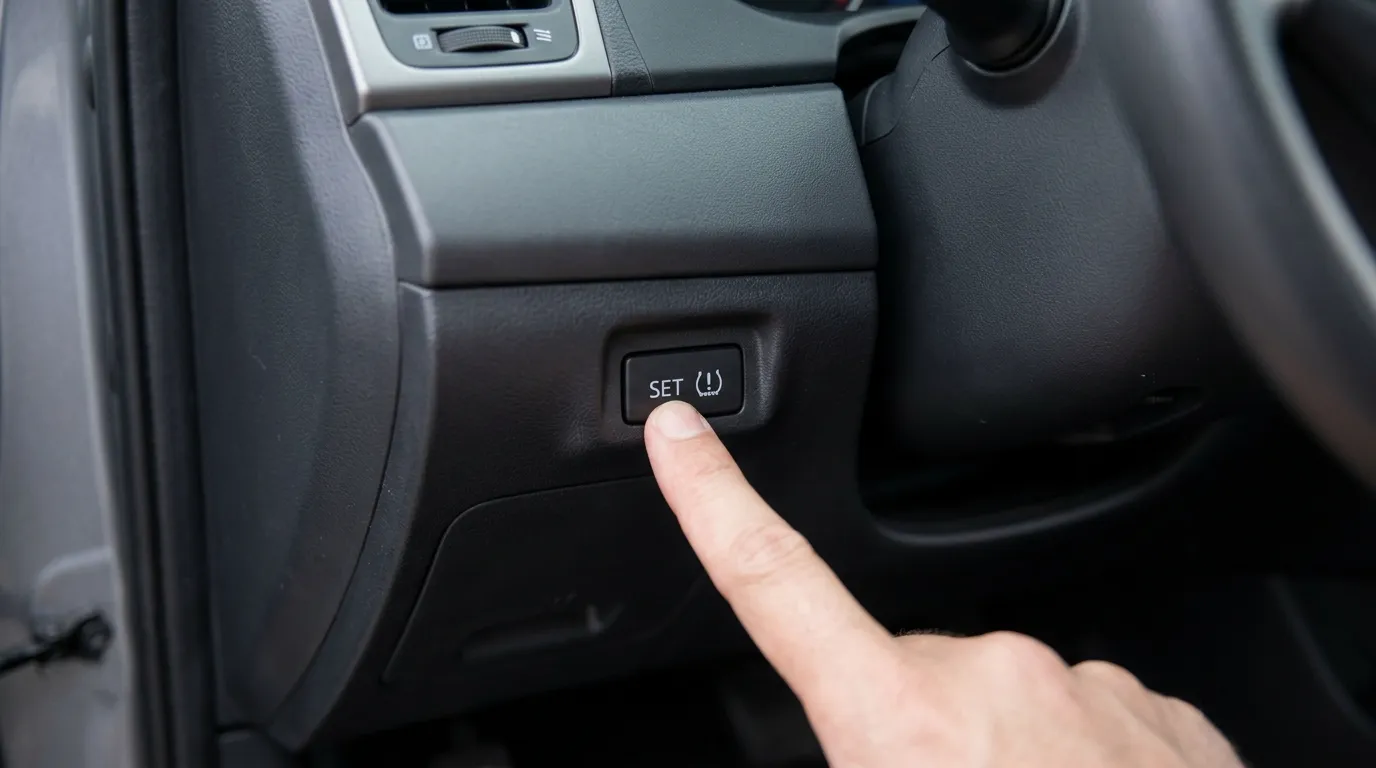
Many vehicles include a dedicated TPMS reset button, often located under the steering wheel, in the glove box, or near the fuse panel.
- Turn the ignition to “on” without starting the engine.
- Locate and press the TPMS reset button.
- Hold it until the tire pressure light blinks three times.
- Release the button and start the engine.
- Drive for about 20 minutes to let the system recalibrate.
5.3 Dashboard/Infotainment Menu Reset
Increasingly common on newer vehicles with digital displays.
- Open the vehicle Settings menu on the touchscreen.
- Navigate to Tire Pressure or TPMS.
- Select Reset or Calibrate.
- Confirm, then drive for a few minutes to complete recalibration.
5.4 Battery Disconnect Method
A workaround for cars without a dedicated reset button, often used on older models.
- Turn off the engine.
- Disconnect the negative battery terminal.
- Press and hold the horn for about 3 seconds to drain residual power.
- Reconnect the battery.
- Start the car and idle for a few minutes to let the system re-initialize.
5.5 OBD-II Scanner / TPMS Relearn Tool
For direct TPMS systems that need each sensor’s ID reprogrammed into the car’s computer common after sensor replacement.
- A TPMS relearn tool (handheld, often affordable to buy or rent) activates each sensor individually while you follow on-screen or manual prompts.
- Some higher-end OBD-II scanners include TPMS reset/relearn functions.
- This is the most technical DIY option and may not be worth it for a one-time fix but useful if you frequently rotate tires or swap wheel sets yourself.
Comparison Table
| Method | Best For | Difficulty |
| Drive Reset | Indirect TPMS, minor fluctuations | Easy |
| Reset Button | Direct TPMS with dedicated button | Easy |
| Dashboard Menu | Newer vehicles, digital settings | Easy |
| Battery Disconnect | Older vehicles, no reset button | Moderate |
| OBD-II/Relearn Tool | Sensor replacement, frequent tire swaps | Advanced |
Make-Specific Quick Reference
TPMS reset procedures vary significantly by manufacturer and often by model year within the same brand. Always confirm with your owner’s manual, but here’s a general starting point:
Toyota / Lexus: Older models often have a TPMS reset button under the steering wheel, on the dashboard, or in the glove compartment press and hold it with the ignition on until the light flashes a few times. 2017 and newer models typically skip the physical button entirely, using the infotainment menu instead: Settings → Vehicle Settings → TPMS Calibration → Calibrate, followed by about 20 minutes of driving. AutoCarsHubTireGrades
Honda / Acura: Most modern Hondas use a calibration process rather than a full sensor relearn. You’ll typically find either a TPMS button or a TPMS Calibration menu accessed through Vehicle Settings on the multi-information display. Full recalibration often requires roughly 30 minutes of driving at speeds between 30–65 mph. OBD AdvisorOBD Advisor
Ford / Lincoln: Many newer Ford models don’t have a physical reset button at all instead you navigate through Settings → Driver Assist → Tire Monitor on the cluster display. Some older or specific models do include a button, typically located near the steering column, and often paired with an ignition-cycling procedure turning the key on and off a few times before driving to complete the relearn. T P Auto Repair
Chevrolet / GMC / Cadillac / Buick (GM): GM uses one of the more involved relearn procedures. The vehicle is put into a stationary learn mode, and each wheel sensor is “taught” to the system in a specific order, often confirmed by a horn chirp after each one. Trucks in particular often need a dedicated TPMS relearn tool, especially after a tire rotation. OBD AdvisorT P Auto Repair
Nissan / Infiniti: These typically use a reset button similar to Toyota’s, usually located in the glove compartment or under the steering wheel hold it until the TPMS light blinks. HiRide
Hyundai / Kia / Genesis: These generally reset automatically after 10–15 minutes of driving with properly inflated tires, though some models include manual reset buttons or menu options as well. HiRide
Subaru: Mostly automatic relearn on newer models some trims allow manual initialization through the menu, but there’s typically no physical reset button. T P Auto Repair
European brands (BMW, Mercedes-Benz, Volkswagen): These generally integrate the reset function into the infotainment or instrument cluster menu, usually under “Vehicle Settings,” “Car,” or “Service.” HiRide
A quick note on GM specifically: GM’s relearn process is initiated with the ignition in the ON/RUN position (engine off), then pressing and holding LOCK + UNLOCK on the keyless entry fob until the horn sounds to enter learn mode. T P Auto Repair
Bottom line: if your dashboard doesn’t have an obvious TPMS button, check the infotainment settings menu first newer vehicles across nearly every brand are moving away from physical buttons entirely.
Troubleshooting: When the Light Won’t Turn Off
If you’ve tried the standard reset methods and the warning light is still on, here’s how to figure out what’s really going on.
Check whether the light is solid or blinking the difference matters. A solid TPMS light usually just means one or more tires are outside the correct pressure range. A light that blinks for about a minute after startup and then stays on is often signaling a system malfunction rather than a pressure issue meaning a sensor itself may have failed or lost communication with the vehicle’s computer.
Consider whether a sensor battery has died. TPMS sensor batteries aren’t replaceable on their own they’re sealed inside the sensor unit, so a dead battery typically means replacing the whole sensor. If your car is more than 6–8 years old and you haven’t had TPMS work done, battery failure is a common and normal cause.
Rule out physical damage. A hard pothole hit, a curb scrape during parking, or a tire shop technician using the wrong tools during a tire change can crack or dislodge a sensor. If the warning appeared right after any wheel-related work, this is worth investigating first.
Distinguish a software glitch from a hardware failure. Sometimes a reset simply doesn’t take the first time. Before assuming a sensor is bad, try the reset procedure again after confirming tire pressure is correct, and give the car adequate driving time some systems need 15–30 minutes of driving to fully recalibrate, and stopping too early can make it look like the reset failed.
Know when a professional relearn tool is unavoidable. Certain situations like a full sensor replacement, or GM/Ford systems that require writing new sensor IDs to the vehicle’s computer genuinely can’t be done with basic driving or button methods. These require a dedicated TPMS relearn/programming tool that shops (and some dedicated DIYers) use to communicate directly with each sensor.
If you’ve gone through all of this and the light persists, it’s a strong sign the issue is a sensor fault rather than a pressure or calibration issue which is where a scan tool or professional diagnosis comes in, covered next.
Maintenance Tips to Avoid Future TPMS Issues
A little routine upkeep goes a long way toward keeping that warning light off for good.
Check tire pressure monthly. Tires naturally lose a small amount of air over time, and pressure shifts with temperature changes. A monthly check with a reliable gauge done when tires are cold catches small drops before they trigger a warning.
Reset after every rotation or seasonal tire swap. Anytime tires are moved between positions or swapped for a seasonal set, the TPMS may need to relearn which sensor belongs to which wheel. Building this into your routine avoids a surprise warning light down the road.
Keep an eye on sensor age. Since TPMS sensor batteries typically last 5–10 years and aren’t replaceable individually, it’s worth noting your car’s age and mileage. If you’re approaching that window and haven’t had any TPMS-related service, a battery-related warning may not be far off.
Choose TPMS-compatible wheels and tires. If you’re switching to aftermarket wheels or a different tire size, confirm they’re compatible with your existing sensors or budget for new sensors as part of the switch. Mismatched components are a common, avoidable source of TPMS headaches.
Don’t ignore a recurring light. A warning that keeps coming back after a proper reset isn’t something to keep dismissing. It’s almost always cheaper and safer to address a slow leak or failing sensor early than to deal with a flat tire or full sensor replacement later.
Maintenance Tips to Avoid Future TPMS Issues
A little routine upkeep goes a long way toward keeping that warning light off for good.
Check tire pressure monthly. Tires naturally lose a small amount of air over time, and pressure shifts with temperature changes. A monthly check with a reliable gauge done when tires are cold catches small drops before they trigger a warning.
Reset after every rotation or seasonal tire swap. Anytime tires are moved between positions or swapped for a seasonal set, the TPMS may need to relearn which sensor belongs to which wheel. Building this into your routine avoids a surprise warning light down the road.
Keep an eye on sensor age. Since TPMS sensor batteries typically last 5–10 years and aren’t replaceable individually, it’s worth noting your car’s age and mileage. If you’re approaching that window and haven’t had any TPMS-related service, a battery-related warning may not be far off.
Choose TPMS-compatible wheels and tires. If you’re switching to aftermarket wheels or a different tire size, confirm they’re compatible with your existing sensors or budget for new sensors as part of the switch. Mismatched components are a common, avoidable source of TPMS headaches.
Don’t ignore a recurring light. A warning that keeps coming back after a proper reset isn’t something to keep dismissing. It’s almost always cheaper and safer to address a slow leak or failing sensor early than to deal with a flat tire or full sensor replacement later.
When to Visit a Professional
Most TPMS light issues can be resolved with the reset methods covered earlier — but there are times when a shop visit is genuinely the faster and safer route.
When a reset simply won’t take. If you’ve properly inflated all your tires, tried the appropriate reset method for your vehicle, and driven the recommended distance, but the light still won’t clear, it’s a sign of an underlying sensor or system issue that basic methods can’t fix.
After a sensor replacement. New sensors typically need to be programmed into your vehicle’s computer using a professional relearn tool. While handheld versions exist for DIY use, many GM and Ford systems in particular require precise procedures that are easy to get wrong without the right equipment.
When you’re unsure which sensor has failed. A shop can run a full TPMS diagnostic scan to identify exactly which sensor is malfunctioning, rather than you guessing based on symptoms alone. This saves you from potentially replacing the wrong part.
Cost expectations. Diagnosing a TPMS issue typically costs relatively little if done alongside other service work, while individual sensor replacement (parts and labor combined) tends to run somewhere in the range of two to three figures per sensor, depending on your vehicle and whether OEM or aftermarket sensors are used. It’s worth asking for a quote before committing, since prices vary by shop and vehicle make.
What a shop does differently. Beyond just diagnostics, most tire shops and dealerships have dedicated TPMS relearn tools that communicate directly with each sensor — something the drive-reset or battery-disconnect methods can’t replicate. This is especially relevant for brands like GM, where the relearn process is more involved than a simple button press.
If your light has been on for more than a few days despite your best efforts, it’s generally worth getting it looked at rather than continuing to guess.
FAQs:
Can I drive with the TPMS light on?
Yes, in most cases it’s safe to drive short distances, but you shouldn’t ignore it long-term. The light means your tire pressure monitoring system has detected an issue often just low pressure, which affects handling, fuel efficiency, and tire wear. Check and correct your tire pressure as soon as possible, and treat a light that won’t clear as a sign to get it checked out.
Why does the light come on in cold weather?
Tire pressure drops about 1 PSI for every 10°F the temperature falls. A cold morning after a warm day is a classic trigger for the TPMS light, even if nothing is actually wrong with your tires. Simply reinflating to the correct PSI usually resolves it.
Does every new tire need a new sensor?
No in most cases, the existing sensor can be reused when you replace a tire, as long as it’s still functioning correctly. However, if a sensor is more than a few years old or shows signs of weak battery life, some shops recommend replacing it at the same time to avoid a repeat visit later.
How long do TPMS sensor batteries last?
Typically 5–10 years, depending on the vehicle and sensor type. Since the batteries are sealed inside the sensor housing, a dead battery usually means replacing the entire sensor rather than just the battery.
Why does my TPMS light blink instead of staying solid?
A blinking light especially one that blinks for about a minute after startup before turning solid or going off often indicates a system malfunction rather than a simple low-pressure warning. This can point to a sensor failure or a system that needs professional diagnosis.
Is TPMS the same as a “tire pressure sensor fault” message?
No. A standard low-pressure warning means your tires need air. A “sensor fault” message means the system itself has detected a problem with a sensor these require different fixes, and a fault message often won’t resolve with a simple reset.
Conclusion:
A stubborn TPMS light is one of those small annoyances that usually has a simple fix but only if you approach it in the right order.
Start by confirming your tires are actually at the correct pressure, figure out whether your vehicle uses a direct or indirect system, and then work through the reset method that matches your car, whether that’s a quick drive, a dedicated button, or a menu on your dashboard screen.
If the light keeps coming back despite your best efforts, don’t keep resetting it and hoping it sticks that’s usually your car telling you a sensor needs attention. A quick trip to a shop for a proper diagnosis will save you more time and money than repeatedly guessing at home.
At the end of the day, TPMS exists to keep you safe and your tires in good shape. A few minutes of maintenance now beats a roadside surprise later.

I am Ethan Carter, a young writer sharing creative ideas and inspiring thoughts on Smartsimiles.com.
I am passionate about spreading knowledge, positivity, and smart smiles through my words.